So, about the exhibit I want to feature in The Notes….
He wasn’t only into depicting ballerinas. He was into a bunch of other activities and women. This is a great exhibit that shows a variety of Degas’ experimental techniques, subject matters and mediums. I wasn’t crazy about him before I saw this exhibition. Well, I didn’t see it, I took a virtual tour. The show was closed two weeks after it started because of the virus. It really would have been worth going to Washington DC to see it.
Here are the points I want to mention first to give some context:
1. This is organized by the National Gallery of Art, Washington, and the Musées d'Orsay et de l'Orangerie, Paris
2. The opera house that Degas depicted was the Paris Opera
3. Music was a lifelong passion for Degas. He grew up raised in a family with a strong appreciation for musical performance. For years his father, Auguste De Gas, hosted weekly musical salons at which amateurs and professionals alike sang and played instruments. Degas was an admirer of the composer Christoph Willibald Gluck. He was also friends with Wolfgang Amadeus Mozart and Johann Sebastian Bach also ranked high in Degas’s esteem, and he counted several contemporary composers among his friends and acquaintances including Charles Gounod and Ernest Reyer.
4. Between 1885 and 1892 he spent 177 evenings in the opera. Quite a few
Let’s go
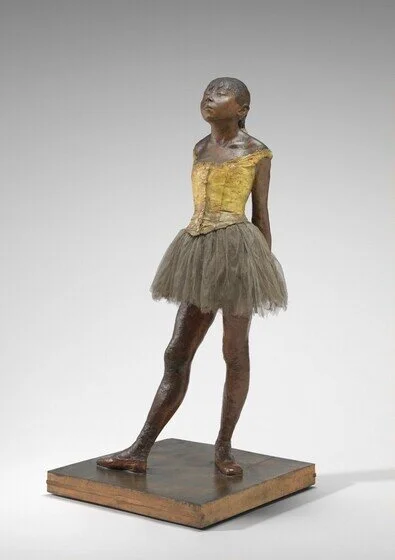
Little Dancer Aged Fourteen, 1878-1881, pigmented beeswax, clay, metal armature, rope, paintbrushes, human hair, silk and linen ribbon, cotton faille bodice, cotton and silk tutu, linen slippers, on wooden base, 39 in.Collection of Mr. and Mrs. Paul Mellon, 1999.80.28
This is creepy. It was made with real human hair, ballet tutu and wax. The sculpture is an icon – one of the most famous sculptures in the world. It received a lot of critique in the 19th century for being too real, even ugly. The material was not as sophisticated, such as marble or bronze. The model for this sculpture was a young 14 year old dancer named Marie Van Gotham. She was from a working class family, who was excluded from the theatre for missing rehearsals.
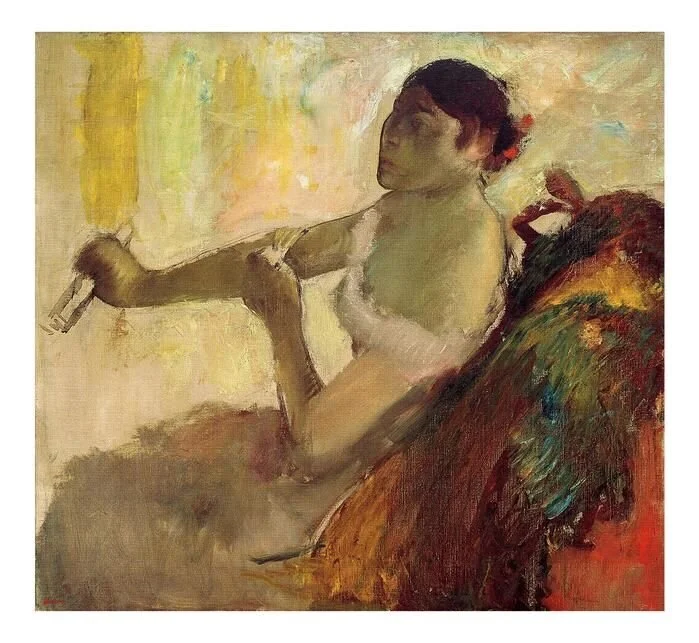
Portrait of Rose Caron, c. 1892, oil on canvas, 30 x 32 1/2 in. Collection Albright-Knox Art Gallery, Buffalo, New York, Charles Clifton, Charles W. Goodyear and Elisabeth H. Gates Funds, 1943
What is noteworthy about this one is that Rose Caron was his favorite performer. She had a part in the opera Sigurd. Degas, wrote a sonnet to her beginning with the words “ These arms noble and long” He admitted he was in love with Rose Caron. Critics honored Rose Caron as the tearless tragic actress, but others were less excited about her voice which was once referred to as wounded. Degas admitted he was in love with Rose Caron .That is why he attended the opera Sigurd 37 times
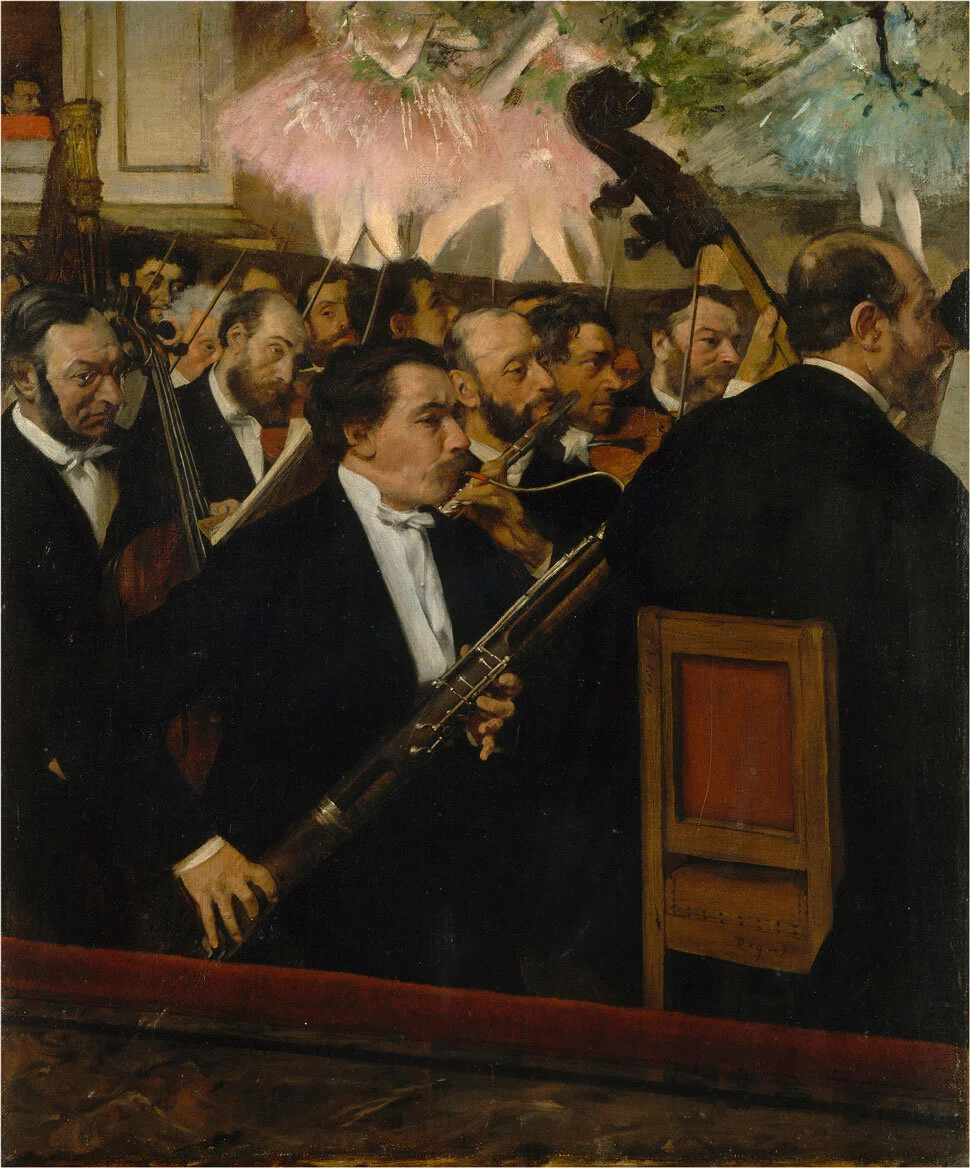
The Orchestra of the Opéra, 1870, oil on canvas, 22 1/5 × 18 1/10 in. Musée d’Orsay, Paris
This work is quite notable: It doesn’t depict actual reality. Degas took a very unconventional approach to depict his friend, Désiré Dihau (the musician in the front row center of Degas’s The Orchestra at the Opéra), showing him at his workplace. The dancers in the background are cut off – the attention of the viewer is focused on Désiré Dihau. Composition however is pure fiction - in reality there would have been four bassoonist, not one, seated with the instruments behind the string section, their backs would have been turned to the audience as they face the conductor at the edge of the stage, Degas did drawings of individual elements, all allowing his creativity to construct to scene that feels very real that exalts in the reality of the implied image without actually ever being a true that the true even that Degas saw. The imagery of the Opera depicted by Degas is derived from his mind. 19th century audiences might have recognized other figures from the Parisian music scene. In the theatre box - composer Emmanuel Chabrier. The man with the glasses on the left - Louis -Marie Pilet
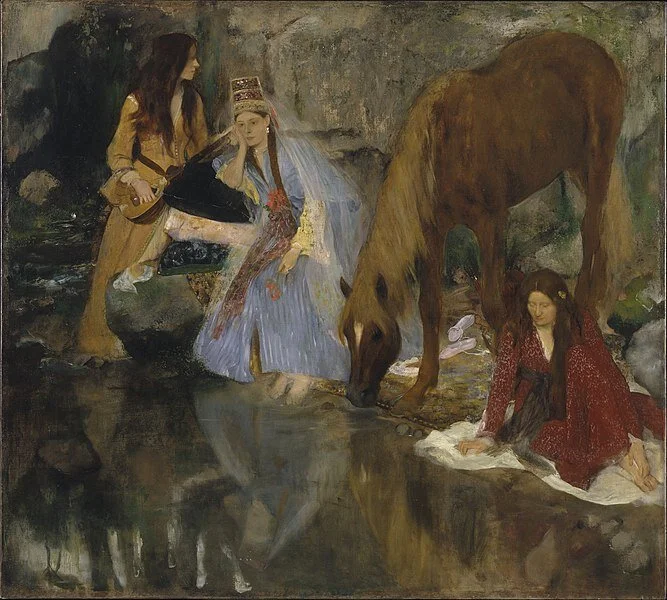
Portrait of Eugénie Fiocre a propose of the Ballet “La Source,” 1867–1868, oil on canvas, 63 x 69 x 6 1/4 in. Brooklyn Museum
The only detail that indicates that this is actually a ballet scene is those pink ballet shoes between the legs of the house( hmm yeah they had a real horse on stage) . This is however not the act itself, they are in the break, because the actresses are resting. Shows women down to earth and approachable. Here we see Degas’ novel approach: this is part portrait, part genre scene, part historical scene. Bravo
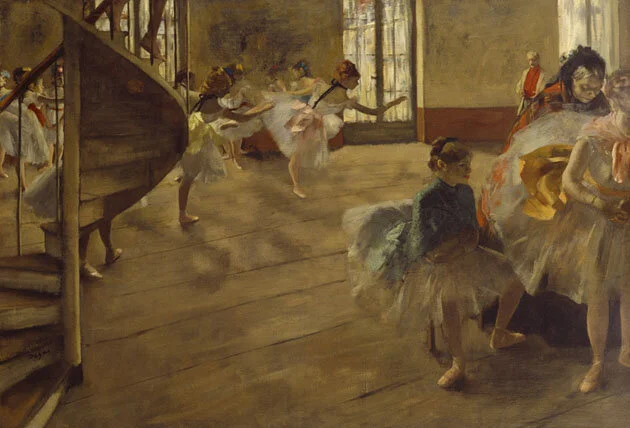
Practicing in the Rehearsal Room 1873-1875, oil on canvas, 16 x 21 1/2 in. Phillips Collection
Not a real dance studio – another example of how Degas directed his paintings – there would never be a staircase in a dance studio. There was one his studio though. That’s how we know - he invited dancers and models to pose for the painting. Busted
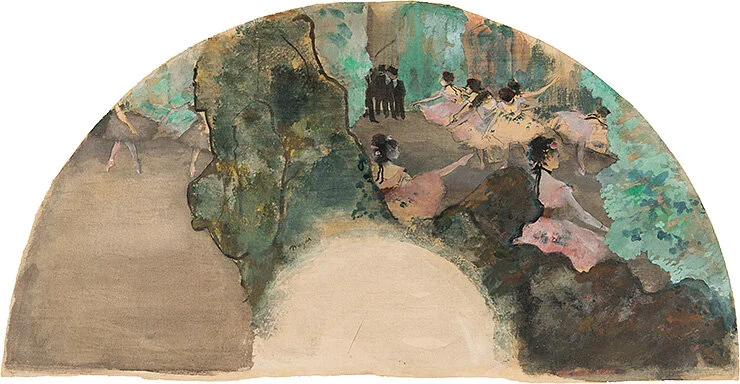
Fan Ballet, Gouache on Silk, 1989 Musée d’Orsay, Paris
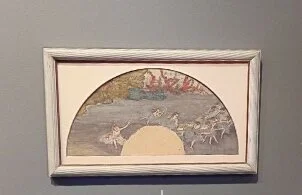
Fan Dancers with Double Basses,1879, pastel, black chalk and ink wash on paper, Kristy Stubbs Gallery, Dallas
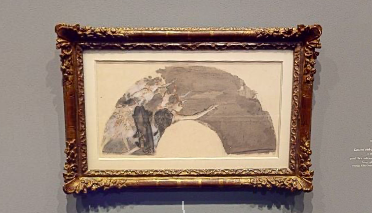
Didn’t expect that did you?
The exhibition has a rare collection of fans depicting opera performances . Degas made only 27 of those, including those which were sold. The gallery presents the largest collection of Degas’s fans ever exhibited - 8 pieces. These fans were made to be framed and hang, not to be used. Degas used mixed media to make them - a combination of ink,watercolor, pastel, charcoal, cotton, fabric, silk, metallic paint. These fans reflect Degas’s influence by japanese art.
To be continued. I am going to look through some other virtual stuff