Pearlstein. Tradition and modernity of his nudes
The coexistence between modernity and tradition in Pearlstein works can be observed throughout his career since his training as an artist. Pearlstein developed his artistic production in the post-war period, after having been recruited by the United States Army to serve during World War II where he produced diagrams of weapons assemblies. The artist later went to Italy, where he traveled through Rome, Venice, Florence, and Milan, and was able to take a classical training based on the great masters of the Renaissance that influenced some of the qualities that define him as a painter.
He settled in New York (you can’t go wrong with that) From 1961 he began to create his characteristic style based generally on naked women posing casually in his art studio. His nudes offered a hyper-realistic and rigorously formalistic approach to the human figure. His particularity lies not only in the modern character of a classical genre but also in the fact that the subject matter and style were a deviation from the artistic context in which it was developed. A number of nudes by Pearlstein demonstrate the domination of his conception of new realism: among those are Two Female Models in the Studio, Two Female Models Sitting on a Blue Homespun Quilt Coverlet, Model with Empire State Building and many others (fig.1, 2, 3). The artist is famous for his “unconventional informality, unpredicted postures and geometric shapes, and “unusual angle standpoints and radical cropping of figures.”
Fig.1
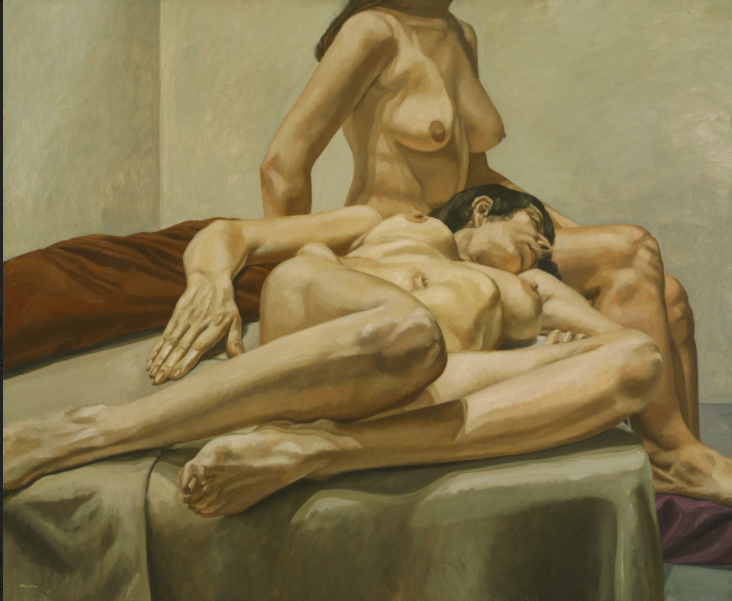
Philip Pearlstein, Two Female Models in the Studio, 1967, Oil on canvas, 50 1/8 x 60 1/4" (127.3 x 153.1 cm), Museum of Modern Art
After the Holocaust and the sense of anguish and disappointment it left, abstract artworks proliferated because artists did not want to be inspired by reality and preferred to portray their inner selves through the expressive nature of the formal elements of art, such as abstract expressionism. Moreover, the popularization of this movement completely transformed the art system. New York became the new center for exhibitions of emerging artists replacing Paris which was the Mecca of classical art for centuries, but Europe was left in crisis after World War II and its most important artists escaped (those who could) and migrated to the United States In this context, avant- garde artists set the trend of rejecting traditional painting conventions, mainly figuration and external references.
Fig.2
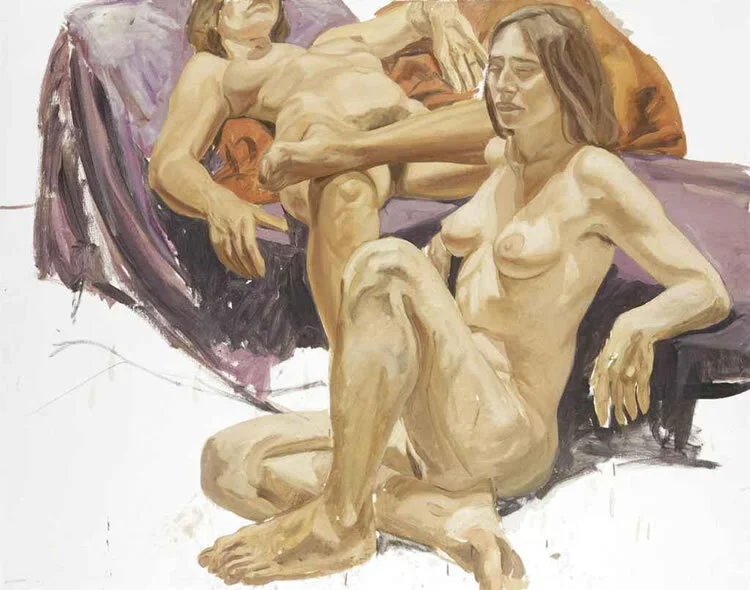
Philip Pearlstein, Two Female Models Sitting on a Blue Homespun Quilt Coverlet 60.83" x 76.77" (154.50cm x 195.00cm),1965, Phillips
Despite Pearlstein's interest in realism, he only shares the mimetic character with the classic nudes of Greek art and later, the Renaissance. The Renaissance artists represented a perfect but plausible -naturalist- version of reality through geometric compositions, with the perspective being the main resource to achieve this due to its illusory effect of depth. These characteristics are related to the context of that time since it was a period of important scientific discoveries that raised individualism and confidence in power of human beings.
Fig.3
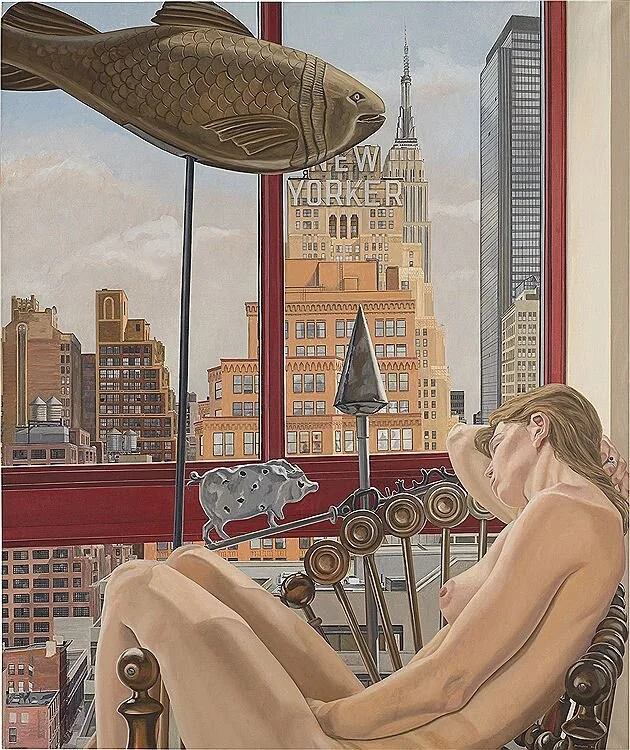
Philip Pearlstein, Model with Empire State Building, Oil on Canvas 72.00" x 60.00" (182.88cm x 152.40cm)
1992, Christie’s
What is it about Pearlstein work that resembles the forms of the classical nude: Urbino&David
Let’s take a closer look particularly atTwo Female Models in the Studio (fig.1) which is at MoMa, not on display(!). Positioning of Pearlstein’s nude figures echoes the Renaissance tradition. The artist portrays women lying down immersed in their thoughts or sleeping peacefully, with their heads tilted. The motif of a female laying down in a relaxed position can be observed in the Titian’s famous Venus of Urbino(fig.4). Titian popularized theme of the nude woman lying down, but challenged the rules by creating an interpretation of Venus, a mythological figure, as a real woman far from the idealized and unattainable portrait of goddesses. For that reason, the work was scandalous for its time, but opened the horizons for realism in the representation of nudes, among them, Pearlstein's style.
Fig.4
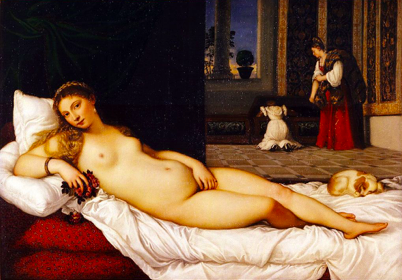
Titian, Venus of Urbino, 1538, Oil on canvas, 119 cm × 165 cm (47 in × 65 in), Uffizi Gallery.
The main difference here is, of course, the portrayal of the physical features of the bodies is. Those are notably visible by the Venus’s sophisticated feminine curves, hand resting on her pubic bone, which is located in the center of the composition and draws the attention of the audience; evenly blended application of the paint creates the sensory experience of the softness of her skin. The implication of a male gaze is reflected through Venus’ approachable flirtatious look at the viewer with her head teasingly tilted; her thick, curvy figure embraces sensuality and femininity of the woman. In other, words, Titian painted pigs…. When I look at 16th century paintings I start having doubts about the whole healthy eating propaganda - there was McDonalds back then, but look how heavy the women are...Well, Pearlstein moves away from the sexuality and feminine curviness of the bodies and rather exaggerates their imperfections: their saggy skin and floppy breasts reflect artist’s unique interpretation of objectivity of their forms. While adopting a Renaissance tradition of positioning female nude figure, when looking at Pearlstein’s naked figures, we can see a clear resemblance with in the Renaissance tradition of a male nude – let’s look at the famous example of Michelangelo’s David (fig.5). The level of detail of the muscles of Pearlstein models create a sensory feeling of three dimensional sculpted figures: the bone structure of the figures is evidently outlined by defined lines of their ribs, limbs and joints. If we take a close look at the right hand of the model in the foreground resting by her side and compare it to David’s right hand, we can observe how similar they are: her large, muscular well defined fingers that are resting by her side resemble the hand of Michelangelo’s sculpture(fig.6,7) The head of the woman lying down is also titled and raised as it is resting on the leg of another model, model’s facial features are portrayed rather muscular: her wide chin and large nose almost make it difficult to identify her gender only by looking at her face(fig.8,9). Peculiarly, Pearlstein implements the traditions of both female and male Renaissance nude, which makes his works so distinct.
Fig.5
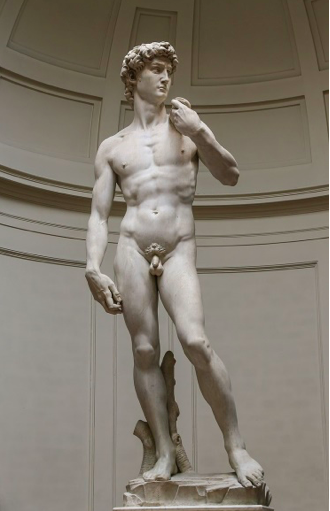
Michelangelo, David, 1501/04, Marble sculpture, 517 cm × 199 cm (17 ft × 6.5 ft), Galleria dell'Accademia.
Fig. 6,7,8,9
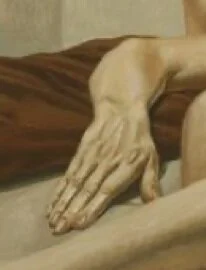
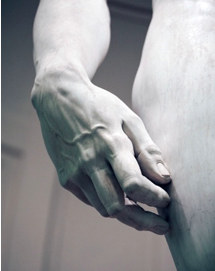
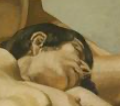
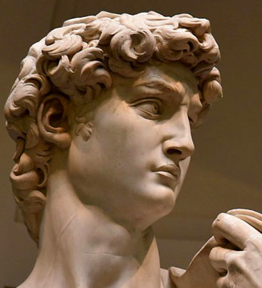
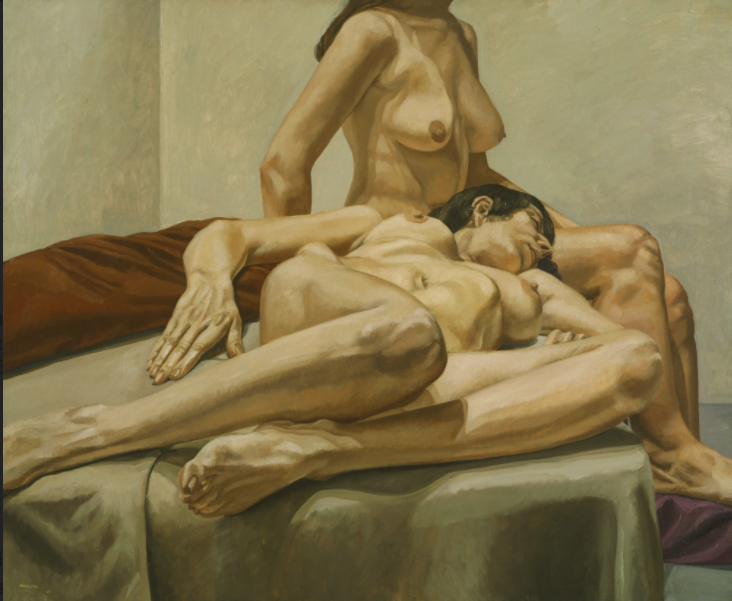
What I am trying to say here is that, in Two Female Models in the Studio we see a laying down David in an Urbino - like pose…
I think he is great. Pearlstein’s nudes are sold by the biggest auction houses including Phillips, Christie’s and Sotheby’s. The estimates of Pearlstein works for sales varies between $50,000 and $170,000 for a piece…
* Writing à la carte - speculating about stuff which I am not interested in. Writing “to order”